> For the complete documentation index, see [llms.txt](https://docs.infotopics.com/llms.txt). Markdown versions of documentation pages are available by appending `.md` to page URLs; this page is available as [Markdown](https://docs.infotopics.com/writebackextreme/v5.0/product-guide/management-console/schemas/workflows/stored-procedures.md).
# Stored procedures
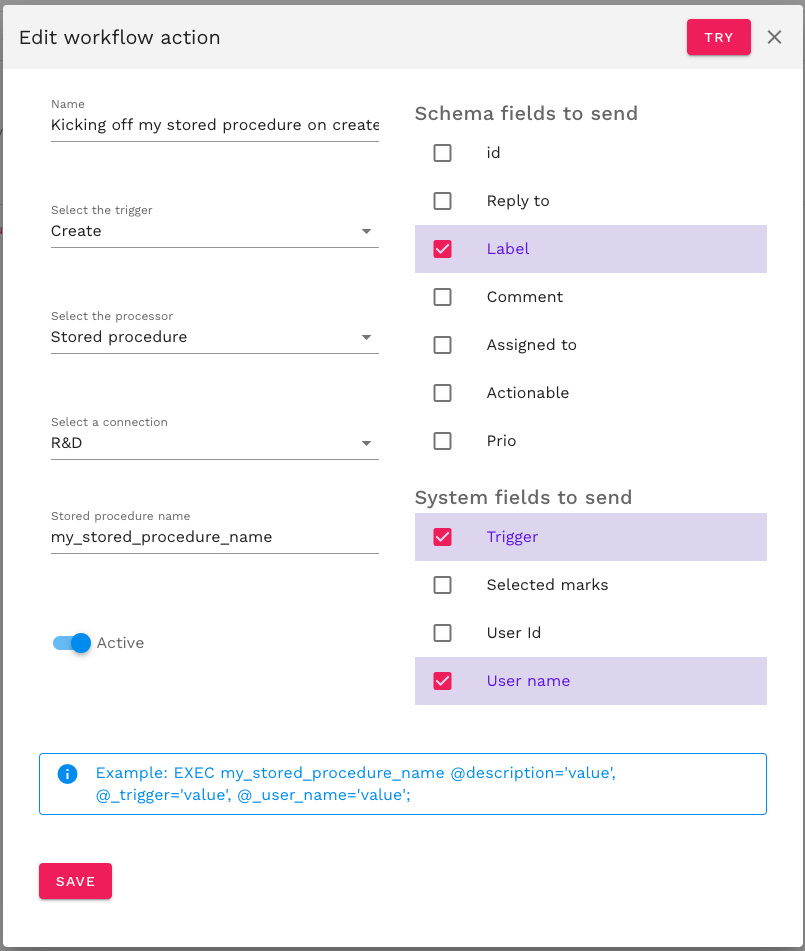
With the stored procedure provider it is possible to call a stored procedure in one of your databases when a record is created, updated, deleted or when a data import has been done.
{% content-ref url="/pages/XZKjQcL0C0ZGEhDLEA1V" %}
[Tutorial (video)](/writebackextreme/v5.0/product-guide/management-console/schemas/workflows/tutorial-video.md)
{% endcontent-ref %}
On the bottom you can find the actual statement that will be executed on the database when the workflow is triggered. The Try now button on the top right will execute this statement directly to test the execution.
When the try button does not return an error the stored procedure is executed successfully.
{% hint style="info" %}
For SQL Server it is important that the name of the fields matches the name of the input parameters of your stored procedure
For other databases like MYSQL or PostgreSQL the sequence of the fields matter. As the example in the management console displays, the fields will be sent in the order of the list.
{% endhint %}
## Example in Postgresql
In this example we create a stored procedure that will consume 4 fields (user, status, accountmanager and sales\_amount. It will write this data to a table \`stored\_procedure\_data\`.
CREATE TABLE
  public.stored_procedure_data (
    id SERIAL,
    "user" character varying(255) NULL,
    status character varying(255) NULL,
    accountmanager character varying(255) NULL,
    sales_amount character varying(255) NULL,
    created_at timestamp(0) without time zone NOT NULL DEFAULT CURRENT_TIMESTAMP,
    updated_at timestamp(0) without time zone NOT NULL DEFAULT CURRENT_TIMESTAMP,
    PRIMARY KEY (id)
  );

CREATE OR REPLACE procedure MyStoredProcedure(
   "user" character varying,
   "status" character varying,
   "sales" character varying,
   "name" character varying
)
language plpgsql
as $$
begin
    INSERT INTO stored_procedure_data ("user", "status", "accountmanager", "sales_amount")
    VALUES ("user", status, name, sales);
    commit;
end;$$
## Example in MySQL
```
CREATE TABLE
stored_procedure_data (
`id` bigint unsigned NOT NULL AUTO_INCREMENT,
`user` VARCHAR(255) NULL,
`status` VARCHAR(255) NULL,
`accountmanager` VARCHAR(255) NULL,
`sales_amount` VARCHAR(255) NULL,
`created_at` timestamp NOT NULL DEFAULT CURRENT_TIMESTAMP,
`updated_at` timestamp NOT NULL DEFAULT CURRENT_TIMESTAMP,
PRIMARY KEY (`id`)
) ENGINE=InnoDB DEFAULT CHARSET=utf8mb4 COLLATE=utf8mb4_unicode_ci;
DELIMITER //
CREATE PROCEDURE MyStoredProcedure (
IN user VARCHAR(255),
IN status VARCHAR(255),
IN sales VARCHAR(255),
IN name VARCHAR(255)
)
BEGIN
INSERT INTO stored_procedure_data (`user`, `status`, `accountmanager`, `sales_amount`)
VALUES (user, status, name, sales);
END //
DELIMITER ;
```
[^1]:
---
# Agent Instructions
This documentation is published with GitBook. GitBook is the documentation platform designed so that both humans and AI agents can read, navigate, and reason over technical content effectively. Learn more at gitbook.com.
## Querying This Documentation
If you need additional information that is not directly available in this page, you can query the documentation by asking a question.
Perform an HTTP GET request on the following URL with the `ask` and `goal` query parameters:
```
GET https://docs.infotopics.com/writebackextreme/v5.0/product-guide/management-console/schemas/workflows/stored-procedures.md?ask=&goal=
```
`ask` is the immediate question: it should be specific, self-contained, and written in natural language.
`goal` is what the user is ultimately trying to achieve, the reason they need the answer. Sharing it helps GitBook give you a better, more relevant answer. A goal is most helpful when it describes the outcome the user wants rather than restating the question. For example, with `ask=how do I create an API token`, a goal like `automate deployments from our CI pipeline` lets GitBook tailor the answer to that use case.
The response will contain a direct answer to the question and relevant excerpts and sources from the documentation.
Use this mechanism when the answer is not explicitly present in the current page, you need clarification or additional context, or you want to retrieve related documentation sections.