> For the complete documentation index, see [llms.txt](https://docs.infotopics.com/llms.txt). Markdown versions of documentation pages are available by appending `.md` to page URLs; this page is available as [Markdown](https://docs.infotopics.com/extensionsmanager/installation-guide/configuration.md).

# Configuration

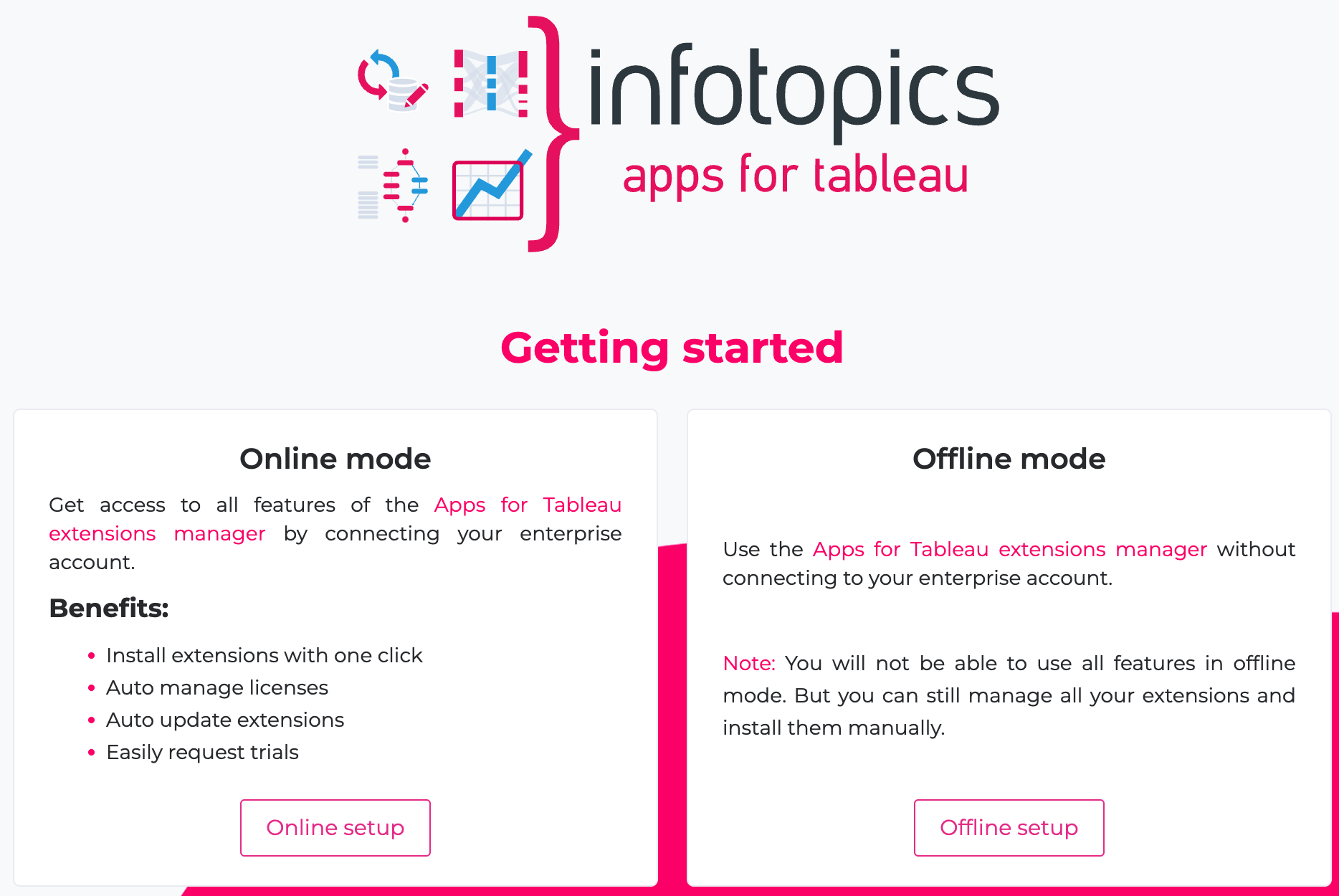
When running the executable, you will be greeted by the following screen. Here you will have the choice between online and offline setup of extensions. Below you will find detailed descriptions of each method of extension management through the ExtensionsManager.

<figure><img src="https://appsfortableau.infotopics.com/wp-content/uploads/2023/09/RH-.png" alt=""><figcaption></figcaption></figure>

### First time setup

When setting up the **Extensions Manager** for the first time, you’ll be asked to choose between **Online** and **Offline** configuration modes.\
Select the option that best fits your environment and setup requirements:

#### Online

Choose **Online** if:

* Your environment has access to the internet.
* You want the **easiest installation and upgrade experience** — products can be installed or updated with a simple clicks.
* You prefer **automatic license management** and quick login using your **Apps for Tableau Portal account**.

#### Offline

Choose **Offline** if:

* Internet access is **restricted or unavailable** in your environment.
* You’re prepared to **manually download** extensions and license files from the Apps for Tableau Portal  and install them into the **Extensions Manager** using the instructions.

<table data-view="cards"><thead><tr><th></th><th></th><th></th></tr></thead><tbody><tr><td><h4>Online Configuration</h4><p>Install, configure and update your Apps for Tableau products with a single click using the Online AFT ExtensionsManager.</p></td><td></td><td><a data-mention href="/extensionsmanager/installation-guide/configuration/online-configuration.md">Online Configuration</a></td></tr><tr><td><h4>Offline Configuration</h4><p>Even without an internet connection you can install and configure your Apps for Tableau products from the ExtensionsManager.</p></td><td><h4><a data-mention href="/extensionsmanager/installation-guide/configuration/offline-configuration.md">Offline Configuration</a></h4></td><td></td></tr><tr><td><h4>Features Overview</h4><p>See all the features the Apps for Tableau ExtensionsManager has to offer to get you started with extensions right away.</p></td><td></td><td><a data-mention href="broken://pages/zBmsqzkGR0MxV43fJGPc">Broken link</a></td></tr></tbody></table>


---

# Agent Instructions
This documentation is published with GitBook. GitBook is the documentation platform designed so that both humans and AI agents can read, navigate, and reason over technical content effectively. Learn more at gitbook.com.

## Querying This Documentation
If you need additional information that is not directly available in this page, you can query the documentation by asking a question.

Perform an HTTP GET request on the following URL with the `ask` and `goal` query parameters:

```
GET https://docs.infotopics.com/extensionsmanager/installation-guide/configuration.md?ask=<question>&goal=<user_goal>
```

`ask` is the immediate question: it should be specific, self-contained, and written in natural language.
`goal` is what the user is ultimately trying to achieve, the reason they need the answer. Sharing it helps GitBook give you a better, more relevant answer. A goal is most helpful when it describes the outcome the user wants rather than restating the question. For example, with `ask=how do I create an API token`, a goal like `automate deployments from our CI pipeline` lets GitBook tailor the answer to that use case.

The response will contain a direct answer to the question and relevant excerpts and sources from the documentation.

Use this mechanism when the answer is not explicitly present in the current page, you need clarification or additional context, or you want to retrieve related documentation sections.
