> For the complete documentation index, see [llms.txt](https://docs.infotopics.com/llms.txt). Markdown versions of documentation pages are available by appending `.md` to page URLs; this page is available as [Markdown](https://docs.infotopics.com/powerkpis/features/style-kpi-cards/metric-attributes.md).
# Metric attributes
For each KPI card defined in the Set up PowerKPIs part, you can set up **different metric attributes** to define the style of your KPI cards.
Metric attributes
### Steer type & accepted tolerance
Steer Type, in combination with Accepted Tolerance, defines the **steering logic** for your KPIs, such as whether a positive variance is favorable, unfavorable, or neutral.
Accepted Tolerance can be used to **define thresholds for the steering logic to be applied**. A variance within the tolerance would be considered neutral.
### Chart types
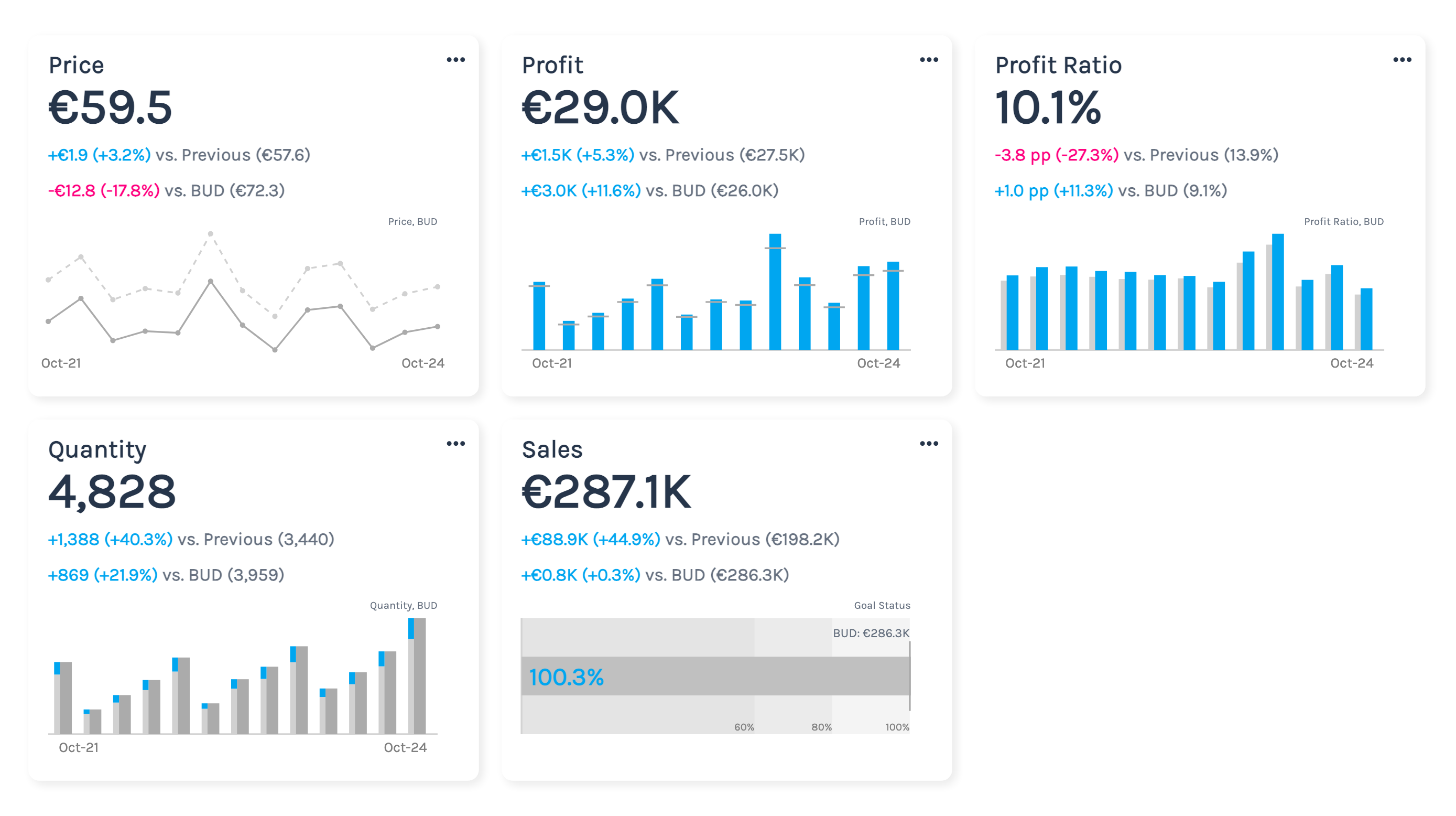
Choose from **five different visualization types** (line charts, side-by-side bar charts, bullet charts, bar charts + variances, goal status chart) for the trend charts.
Available Chart Types
### Number formats
Figures can be formatted as **Numbers, Currencies, or Percentages**, taking into account the number of decimals defined here.
By default **Auto precision** (see above) is turned on, but setting custom **Decimals**, **Prefixes** or **Suffixes** are also possible.
### Link types and labels
Only relevant for **Tree layouts**:
The relationship between a KPI and its parent KPI can be hard (mathematical or direct impact) or soft (non-mathematical or indirect impact). Hard relationships are represented by solid links between KPIs, and soft relationships are represented by dashed links.
In Link Label add any text to be displayed on the link between a KPI card and its parent KPI.
### Description
Here any description can be added to show additional context for a measure. The description can be shown when clicking the "..." on a card.
Context Pop-Up
### URLs
Leverage the power of the Tableau platform by linking PowerKPIs to Tableau Pulse and other Tableau dashboards.
Furthermore, add any link to additional sources like dictionaries, videos, or implement links to provide feedback from your users.
Add custom URLs to your KPI cards
---
# Agent Instructions
This documentation is published with GitBook. GitBook is the documentation platform designed so that both humans and AI agents can read, navigate, and reason over technical content effectively. Learn more at gitbook.com.
## Querying This Documentation
If you need additional information that is not directly available in this page, you can query the documentation by asking a question.
Perform an HTTP GET request on the following URL with the `ask` and `goal` query parameters:
```
GET https://docs.infotopics.com/powerkpis/features/style-kpi-cards/metric-attributes.md?ask=&goal=
```
`ask` is the immediate question: it should be specific, self-contained, and written in natural language.
`goal` is what the user is ultimately trying to achieve, the reason they need the answer. Sharing it helps GitBook give you a better, more relevant answer. A goal is most helpful when it describes the outcome the user wants rather than restating the question. For example, with `ask=how do I create an API token`, a goal like `automate deployments from our CI pipeline` lets GitBook tailor the answer to that use case.
The response will contain a direct answer to the question and relevant excerpts and sources from the documentation.
Use this mechanism when the answer is not explicitly present in the current page, you need clarification or additional context, or you want to retrieve related documentation sections.