> For the complete documentation index, see [llms.txt](https://docs.infotopics.com/llms.txt). Markdown versions of documentation pages are available by appending `.md` to page URLs; this page is available as [Markdown](https://docs.infotopics.com/dashboardusage/features/event-tracking.md).
# Event tracking
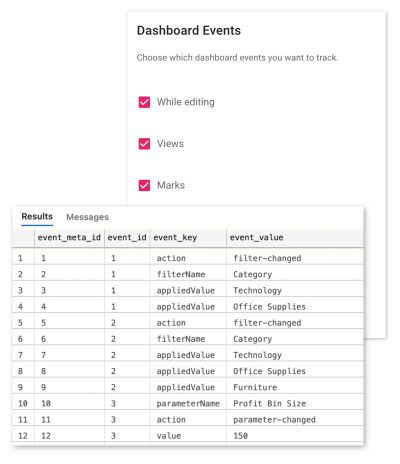
In the Dashboard Usage configuration pane, you can find options to customize how you want the dashboard events to be logged into your database. The following options are available in the Event tracking section of the configuration pane.
1. While editing (whether or not to track events while editing the workbook)
2. Views (track views)
3. Marks (track mark selections)
4. Filters (track filter changes)
5. Actions (track use of dashboard actions)
6. Parameters (track parameter changes)
The information logged for every event is different, even for the same type of event. For example; a range filter will log a different set of data than a categorical filter.
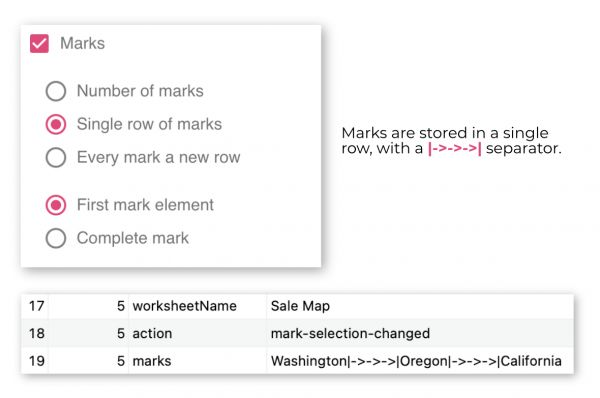
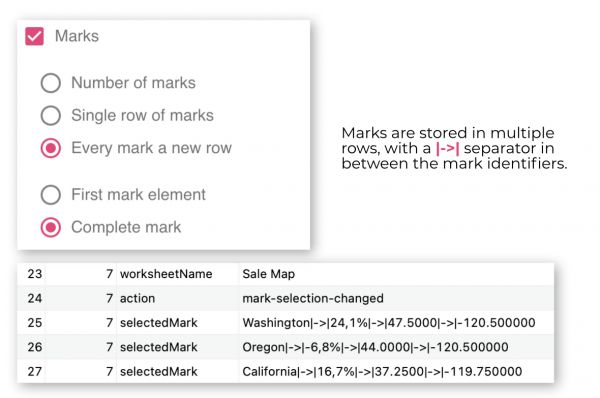
For mark, filter and action tracking you can specify how to store the data. As standard, all values are stored in a single row (a record). However, you can choose to only store the number of values or store every item on a new row. Additionally, you can choose to store the full mark information or only its first identifier. When storing all values in a single row, different items will be separated by the following characters: **|->->->|**. When storing the full mark path, mark items will be separated with the following characters: **|->|**. For a visual explanation, see the images below.
In summary, These configurations help you to define the granularity of logged information from the dashboard usage. It’s up to you to decide what kind of information you need to track from users of the dashboard extension, to formulate actionable information.
---
# Agent Instructions
This documentation is published with GitBook. GitBook is the documentation platform designed so that both humans and AI agents can read, navigate, and reason over technical content effectively. Learn more at gitbook.com.
## Querying This Documentation
If you need additional information that is not directly available in this page, you can query the documentation by asking a question.
Perform an HTTP GET request on the following URL with the `ask` and `goal` query parameters:
```
GET https://docs.infotopics.com/dashboardusage/features/event-tracking.md?ask=&goal=
```
`ask` is the immediate question: it should be specific, self-contained, and written in natural language.
`goal` is what the user is ultimately trying to achieve, the reason they need the answer. Sharing it helps GitBook give you a better, more relevant answer. A goal is most helpful when it describes the outcome the user wants rather than restating the question. For example, with `ask=how do I create an API token`, a goal like `automate deployments from our CI pipeline` lets GitBook tailor the answer to that use case.
The response will contain a direct answer to the question and relevant excerpts and sources from the documentation.
Use this mechanism when the answer is not explicitly present in the current page, you need clarification or additional context, or you want to retrieve related documentation sections.